Chesterfield Cricket Lovers' Society

Our next meeting is on Wednesday 15 February 2012, when we look forward to a return visit by Richard Kettleborough, a greatly respected umpire, who is now a member of the ICC Elite Panel.

VISIT OF MEMBERS OF THE DERBYSHIRE CRICKET ACADEMY

A slightly unusual format to our Meeting in Queen's Park on Monday 16th January when we were entertained by members of this year's students of the Derbyshire Cricket Academy. We were reminded that when the Academy had been set up - in November 2004 - the early sessions had taken place in the drafty, crumbling, old Cricket School at the County Ground (which at least had the advantage of being bomb-proof, because of its concrete roof!). Soon, though, operations had been moved into the spanking new state-of-the-art facilities of the Gateway Centre, constructed on the site of the old Racecourse Grandstand. So far thirty nine "students" had passed through the Academy, of whom fifteen had subsequently played First Class, or Category "A" County Cricket. Six former students currently held full time Cricket Contracts; another six had Summer Contracts. For the majority of the Academy's lifetime Karl Krikken had been its Director, but since his elevation to the post of Derbyshire's Head of Cricket that position had been occupied by Howard Dytham.

Five of the current crop of students were in attendance at our Meeting - Harry White, Ben Cotton, Mykolo Bird, Tom Taylor and - by no means least - Chesterfield C C's own young star, Matt Fletcher. They were accompanied by one of the coaches, Andrew "A J" Harris, the former Derbyshire, Nottinghamshire, Leicestershire and England "A" seam bowler.

Mr. Harris explained the ethos of the Academy and pointed out that, in the end, it was the Players' Academy - to be run as they felt was best for their development. He emphasised, too, that the Academy Staff were very dependent on the support and co-operation of the parents and school Headmasters, with whom they worked in close conjunction. School studies needed to be fitted in to the equation; also the fact that some students also had other sporting and leisure interests - two of our guests played football, for instance, albeit mainly to help to maintain their level of fitness during the winter and another was trying out Golf. The Academy ran for 22 weeks, from early November until late March, with a short break for Christmas. The players met on two evenings a week throughout this period, although there was a certain amount of flexibility in this regard, bearing in mind the need to work around school commitments. In the Summer they competed in local Cricket as the "Derbyshire Colts" and had won the Derbyshire Premier Cup in 2011.

Questions from the floor ranged around various topics, such as:

the "catchment" area for recruitment - Mr. Harris said that the Academy had welcomed players from Staffordshire, Cheshire and Shropshire as well as Derbyshire;

the well publicised problems caused by depression amongst some Cricketers - the County had recruited specialist mentors and advisers to advise on that aspect of the Academy's responsibilities and;

priorities in the Summer - what happened for example if there was a clash between a club cricket commitment and an important School fixture;

as well as a number of more light-hearted questions.

All in all another enjoyable evening, not least because of the very mature and responsible attitude and thought-provoking views expressed by the young students.

Earlier in the evening the Chairman, David Marshall, had welcomed our Treasurer, Niven Roper to the Meeting, following his health "scare" over the Christmas period, which had necessitated an emergency admission to Hospital for a week's stay. He was now starting gingerly to find his feet again.


VISIT OF MICK NEWELL ON 1ST DECEMBER 2011

The Society's final meeting before the Christmas break saw a welcome return visit by Mick Newell, the former Nottinghamshire batsman who, for the last decade has been the Head of Cricket at Trent Bridge, during which time the County has enjoyed considerable success. A number of high profile players have been attracted to the Club in recent years - an announcement had been made only that morning of the signing from Leicestershire of the young star batsman, James Taylor - and so well respected has Mr. Newell become on the management side of the Game that he has coached England Under 19s (on tour to Bangladesh) and also the English Lions.

Mick began by jokingly telling us that one of his less welcome records as a player is that he scored more career runs in County Second X1 Cricket than anybody else, narrowly surpassing the late Neal Abberley, of Warwickshire (who sadly died earlier this year). What that told us, said Mick, was that he had spent too much of his playing career in the Second Team rather than with the Firsts. To what did he attribute his success as the Nottinghamshire Coach? He felt that every excellent Sports Team needed a good backroom staff. Mick felt he had achieved this by having in place specialist coaches to cover all of Cricket's disciplines. His own knowledge of how to coach fast bowling, for instance, was nowhere nearly as strong as that relating to batting, but the ace up his sleeve was that he knew Mike Hendrick's phone number.

In learning how to become a highly successful top class Coach/Cricket Manager Mr. Newell was quick to praise a number of people who had been on hand to guide him, but he had especial praise for the former Head of Cricket, Ken Taylor, whose wise counselling had been invaluable. He had kind words, too, for the Trent Bridge Groundsman, Steve Birks, who, he reminded his audience, had learned his craft at Derby.

A perennial headache for the Manager was the fact that several of Nottinghamshire's Test stars seemed to be so rarely available for County duty. Broad had played in, perhaps, ten or so Championship Matches over the past four years; Swann in even fewer. Mick was obliged constantly to keep his eyes peeled for worthwhile (and available) short term replacements - often overseas players - for these absentees.

Our guest disagreed with the frequent tinkering by the "Powers-that-Be" with the format of the domestic County programme. He felt that Championship Cricket should be kept at 16 Matches per Season and not reduced any further, as had recently been suggested. There was nothing wrong, either, with 40 overs per Side domestic One Day Cricket. Leave the present structure alone!

Another articulate and thought-provoking Speaker, with a friendly sense of humour. As David Marshall summarised at the end, we had enjoyed the company of several excellent guests at recent Meetings, although none better than Mr. Newell.

Earlier Mr. Marshall had outlined to members an updated report on progress towards the Society's 50th Anniversary Celebrations in 2012/13 and names were taken of those who expressed interest in attending the first major event , which was to be a visit (with pie and pea supper) to Chesterfield F C's B2Net Stadium of Christopher Martin-Jenkins in October 2012.


VISIT OF ROGER KNIGHT, OBE

More than sixty members and guests were in attendance for the visit on Wednesday 16th November of Roger Knight, the former Surrey Captain, who, after Cambridge University, had also fitted in a distinguished teaching career with spells at Gloucestershire and Sussex. There had then followed over twelve years` service as Secretary/Chief Executive of MCC.

It was Mr. Knight's first visit to The Society since he had turned out for us on a particularly bitterly cold and snowy evening in the early 1990s, whilst Headmaster of Worksop College. He told us, however, that this was the first time he had been to Queen's Park since 1973 when, on the day after Gloucestershire had won the Gillette Cup at Lord's, they had been required to fulfil a Sunday League Fixture against Derbyshire. Unfortunately, not everybody had arrived in Chesterfield by the 2pm start time, which meant that Roger and off spinner John Mortimore had been obliged to open the bowling.

Mr. Knight devoted much of his address to his experiences as an Administrator at Lord's . He saw his role as Secretary/Chief Executive of MCC as being threefold. First, he had to run a private members' club, which was seventeen thousand strong. Apart from anything else this entailed organising about 400 Matches per Season for members to play in various parts of the country. The vast majority of these MCC One Day Fixtures were still played on a "timed" basis, with declarations to be considered, a format which our guest preferred to the "Limited Overs" concept, since it encouraged bowlers to take wickets rather than merely to restrict runs. In addition to Cricket, incidentally, MCC ran other Societies/Membership Groups, encompassing such activities as Golf, Real Tennis, Chess and Bridge.

Secondly, he had duties to administer Lord's. During his time as Chief Executive he had seen a number of major changes - the new Indoor Cricket School, new offices for the ECB, the new Grandstand and, of course the Media Centre. His third function had been as an ambassador for the Game,

Mr. Knight discussed the current position of MCC within the Game. It had written out the Laws of Cricket in 2000 and was Custodian of those Laws, It was also, however, Custodian of the Spirit of the Game, which meant Respect - for your own team colleagues; for the opposition and the Umpires; and for the traditional values of Cricket. He had been dismayed by the recent "spot-betting" scandal.

Since retiring from his post at Lord's in 2006 Mr. Knight had remained active in Cricket administration, having served as President of Surrey and of Cambridge University C C. He was also on the Board of Governors of a School in Taunton.

In "Questions and Answers" Roger ranged over such diverse topics as: the preparation of Lord's for its part in the 2012 Olympics; the impact of the introduction of Lady MCC Members; the use of technology in order to aid umpiring decisions; and some reminiscences of his experiences as a County Cricketer.

All in all, it was a thoroughly inspiring and educative evening for all of us, from a splendid Speaker.

We were pleased to welcome back as Chairman David Marshall, looking remark fit and well after his recent confrontation with the Surgeon's knife, followed by a spell of "Grandpaternity" leave in Kent. Members stood in silent respect for Jean Cockell, a founder member and Vice President, who had recently died. It was also announced that Mrs Doreen Buxton, the widow of Former Derbyshire Captain, Ian, had accepted the invitation to become a Vice President.


VISIT OF CLIVE RADLEY, MBE - Wednesday 5th October 2011

It was an honour for us to be able to open our 49th Season with a visit from Clive Radley, MBE, who has worked at Lord's for five decades, first as a very fine batsman and fielder with Middlesex and then, latterly , as Head of the MCC Cricket School.

In the early 1960s Clive had been at school in Norwich and was spotted playing for Norfolk by the former Middlesex and England icon, Bill Edrich, who had promptly recommended the young man to his old County. In the late 1970s Clive had enjoyed an all-too-brief Test career (he won 8 Caps), but in all spent 23 Seasons with Middlesex, before taking up his coaching appointment with MCC. Mr. Radley's run in the Test Team began when he received an urgent phone call in Australia one night (where he was carrying out a Winter's coaching engagement). He was instructed to make his way post haste to Lahore, as he was to replace Mike Brearley, who had broken his hand. In the event Clive did not play in that Test - the plane he was on had broken down in Bangkok and so he was too late to be considered for selection - but did gain his cherished .Three Lions. a few weeks later in Christchurch, when the touring team had moved on to New Zealand. Clive's first match was the famous one when quick runs were required in England's Second Innings in order to set up a meaningful declaration on the last day, but some of the players felt, rightly or wrongly, that Captain Boycott was not scoring as freely as was required, Ian Botham then went in and ,very shortly afterwards, G Boycott was run out. Whether this was by accident or design, the runs began to flow more quickly thereafter (Geoff Miller 89), a target was set and England squared the Series.

Clive spoke with affection of the many well known cricketers with whom hw had played over the years and had amusing anecdotes regarding such names as Fred Titmus, Brian Close, Mike Brearley, John Price - and even Derbyshire's Harry Cartwright! Titmus had been his great hero at Middlesex and he also spoke admiringly of the two spin twins of a slightly later era, Edmonds and Embury, who, with their diverse bowling styles, had complemented each other and had done so well for County and Country. Mr. Radley had few memories of matches in which he had played on Queen's Park (he modestly said that this was due to the fact that he had never managed to score any runs there - not entirely true!) but, quite apart from its attractive setting, the Ground had always been highly regarded by professional cricketers because of the fast pace of the pitch - not always the case with the more northerly Grounds.

Questions and Answers ranged over a number of issues, including Mr. Radley's thoughts on what makes a good coach, umpiring matters and the newly introduced (on 1st October) Regulations in International Cricket concerning runners for injured batsmen and the use in Limited Overs' Games of a different ball at each end.

Mr. Radley was a most welcome visitor and got our Winter off to a superb start. Acting as Chairman for the first time was John Paulson, whose relaxed knowledgeable and informative style came across very well - he did a fine job as emergency stand in for our much loved Society Chairman, David Marshall, who had entered Hospital that morning for a pre-planned operation and Mike Taylor, who had a business commitment on the day.

Earlier in the evening John Paulson had also chaired an admirably brief AGM, in which we received a progress report on the plans to celebrate the Society's 50th Anniversary Season next year. Best wishes for Mr. Marshall's speedy recovery and return to his rightful position in the Chair were recorded, coupled with similar good wishes to Vice President Jim Brailsford, who had been taken ill very recently. The Meeting stood in silence in memory of the passing of long standing Members - Nick Blackshaw, David Robinson and founder member Ian Buxton - coupled with thoughts for the distinguished Test Cricketer and .Headingley 1981. hero, Graham Dilley, whose death had been announced that morning.


VISIT OF PAT MURPHY - 9TH APRIL 2011


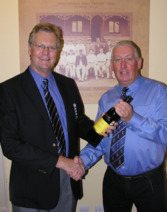
Chairman David Marshall presents Pat Murphy with a bottle of wine after a hugely entertaining evening to round off the Society's winter season.
Picture: Mike Taylor Cook

There was a near-record attendance in the Queen's Park Cricket Pavilion to greet the long awaited visit of PAT MURPHY, the Radio Live Sports Broadcaster. For his part Mr. Murphy said he was honoured to be with us, not least because a Reserved Parking Space had been arranged for him - not always the case at some of the venues which he was obliged to attend in his professional broadcasting capacity when far too often, it seemed, he was obliged to leave his car in a dimly lit side street some distance from where he was required to lug his briefcase, computer, etc. The Chesterfield Cricket Club bar was even serving his favourite "tipple". A good start to the evening, therefore, which became better and better as a highly entertaining, thought provoking and articulate Speaker developed his theme, always seeking to include the audience's views in his discussions. Pat had begun his journalistic career with Peterborough's local newspaper, but had been the BBC's Midlands Sports Correspondent (based in Birmingham) since 1981, combining this with his BBC Five Live duties, for which radio network he has, among other commissions, covered 15 Overseas Test Series. Also a prolific author, Mr. Murphy produced for us a World Cricket XI comprised exclusively of players with whom he had collaborated in the publication of books. So strong was the Team that three outstanding names who were eligible for selection (Andrew Flintoff, Chris Broad and Bob Taylor) had to be omitted. Pat was the first to point out that his Team was weak on spin bowling - it would be left to Sir Vivian to "tweak" a few of his off breaks - and there was also some uncertainty as to who should be entrusted with the captaincy - D'Oliveira got his vote, with Procter as Vice Captain.

On other matters Mr. Murphy had enormous affection and admiration for Brian Clough as well as tremendous respect for the recent Aston Villa Manager, Martyn O'Neill. He spoke with compassion regarding the recently published travails of the Sussex & England player, Mike Yardy and was a great admirer of the former Gloucs. & England wicketkeeper, Jack Russell. Of the Cricket broadcasters, John Arlott was his hero and he also had special words of praise for Don Mosey, Christopher Martin-Jenkins, Tony Lewis and Tony Cozier.

A thoroughly riveting speaker who left us all wanting more and a great rounding off of the Society's 48th Season.

Earlier in the evening a cheque had been presented to Mike Taylor in his capacity as Chairman of Chesterfield Cricket Club, to be used for the development of youth cricket within the Club. Our own Chairman, David Marshall, was able to report that plans for The Society's 50th Anniversary Season, in 2012-2013, were well in hand.


VISIT OF PAUL EDWARDS - 9TH MARCH 2011


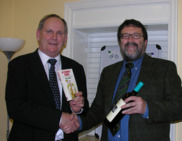
Acting Chairman Mike Taylor (left) presenting Paul Edwards with the customary bottle of wine at the end of another entertaining evening at Queen's Park
Picture: John Cook

We were privileged to be addressed at our March Meeting by PAUL EDWARDS and, from his comments, he was equally pleased to see us, since he announced that he was flattered that so many people had chosen him in preference to Gareth Bale (Tottenham had an important televised European fixture on the same evening). In the absence of our President and Chairman (both vacationing in different parts of the Iberian Peninsula) Mike Taylor ably took the Chair.

Paul Edwards is a long standing freelance journalist, based on Merseyside, who has made frequent contributions to Wisden (both the Almanack and the monthly magazine) as well as to at least two Counties' Yearbooks. He has been Cricket Correspondent to the Liverpool Evening Post and has also written many pieces for the Internet. Mr. Edwards made it clear from the outset that he has a great deal of time for all aspects of Cricket, from Test Matches down to the Recreational Game. He covered the entire 2009 Ashes Series, for example, but surprised many of his colleagues in the Press Box by insisting upon simultaneously updating himself on Club League Cricket Results - particularly, in his case with his own local teams in the Liverpool Competition. He had thoroughly enjoyed the Winter Ashes Series but, in response to a question from the floor, considered that England would need to be at their very best this summer if they were to prevent India from beating them. What particularly attracted him, however, to Test Matches between two fairly evenly-matched Sides was the power of the contest, rather than who eventually won.

Mr. Edwards is a big fan of County Cricket and, in particular, the Four Day Championship format. Even Twenty/20 has a place in the scheme of things - although he was not yet sure where that place was. He was disappointed with the Fixture Schedule for 2011, when, because of the need to prioritise One Day Cricket, many Counties were finding that they would have completed one quarter of their Championship Programme before the end of April , which is not a summer month. Lancashire, for example, had two Championship Matches to fulfil at Liverpool during April - the weather and the bitter breeze blowing from the nearby Mersey permitting, of course.

Our guest spoke highly of Derbyshire's Captain, Luke Sutton - an excellent cricketer and a fine man, with whom he had enjoyed contact during Luke's time at Lancashire.

Paul was all in favour of technology as an aid to procuring correct decisions in International Matches. How the technology was used, however, was crucial to its success. The same level of technology needed to be used consistently in all International Series.

Mr. Edwards told us that he thoroughly enjoyed his role as a freelance journalist, a job which he found very rewarding, but pointed out that he could not get every judgment and prediction correct on every occasion. In 2010, he felt that Jimmy Adams (Hampshire) had made a very strong case for himself to be the opening batsman for the Ashes Series - our guest had seen him play two very impressive innings against Lancashire and Yorkshire respectively. Paul felt that the player to make way for Adams in Australia should be.Alastair Cook (whoops!).

We came away from the Meeting with the impression that Mr. Edwards had a great deal more in the locker about which to talk to us - food, perhaps for a return visit in due course?


VISIT OF COLIN TUNNICLIFFE - 9TH FEBRUARY 2011


Guest speaker Colin Tunnicliffe flanked by former Derbyshire players Harry Cartwright (left) and Jim Brailsford at the Society's February meeting.
Picture: Mike Taylor

There was a large and enthusiastic gathering to greet an old Derbyshire favourite to our February Meeting - the former left arm seamer, Colin Tunnicliffe. We were also pleased to welcome in the audience one of Colin's old County team mates, batsman Harry Cartwright.

Colin played for Derbyshire from 1973 until 1984. There then followed a five years' stint as the County's Commercial Manager, before he took up a similar post with Derby County F C. (During his time there he saw the move from the Baseball Ground to Pride Park). He reminisced light heartedly about his time as a cricketer, never ceasing to be amazed at the fact that he found himself playing with or against some of his boyhood heroes, such as Colin Cowdrey, Garfield Sobers and Michael Holding. Mr. Tunnicliffe made especial mention of Eddie Barlow, under whose captaincy he had served and who had apparently seen sufficient in him to encourage the young man to become a County cricketer. The bravest innings he had ever witnessed was one by John Wright (the current New Zealand Head Coach) who, in May 1980, had battled it out on a lively Queen's Park pitch against the might of the West Indies pace attack (Holding, Marshall, Roberts, Garner, etc.) and had become black and blue in scoring a superb 98. An eventful Match for John Wright culminated in him taking a wicket with his first ever delivery in First Class Cricket - not a "rabbit" either, but the West Indies' opening batsman, Bacchus.

Mr. Tunnicliffe had happy memories of Queen's Park, having achieved his best First Class bowling figures there (7 for 36 against Essex). Then, of course, there was the famous afternoon when Derbyshire were heading towards seemingly inevitable defeat against Surrey in a 40 overs a side Sunday League Match. At the end of the 39th over of Derbyshire's innings they were still 17 runs adrift of victory and had only one wicket in hand. At that point "batsman" Tunnicliffe knocked off the runs (with the aid of two sixes). As he walked triumphantly from the field to great acclaim the distraught visiting team was already starting to conduct its inquest in to where things had gone so badly wrong!

Of course, mention had to be made of the "most famous leg bye in Derbyshire's Cricket history", which enabled the Club to claim the Nat West Trophy from Northants off the last ball of the Final (Colin was batting in partnership with the current National Selector, Geoff Miller, at the time). Our guest mischievously told his audience that it had not really been a leg bye at all and that he had managed to get some bat on ball. With a twinkle in his eye he confided to us that the BBC had a piece of footage indicating a "hot spot" on the bat. (I hadn't previously appreciated that such sophisticated technology was available to the broadcasters back in 1981!).

Another thoroughly enjoyable and memorable evening...


THE VISIT OF GEOFF COOK (DIRECTOR OF CRICKET AT DURHAM C C C ) ON TUESDAY 10TH JANUARY 2011.

The unprecedented weather conditions having caused us to cancel our December Meeting, we were relieved to resume normal business on 10th January with the visit of Geoff Cook to Queen's Park. It was particularly good of him to speak to a very good turnout on that evening, since he had arrived back in the UK only at lunch time from a tour leading a party of young cricketers in the United Arab Emirates.

Born in Middlesborough, Geoff had played out almost his entire First Class career as a very accomplished batsman with Northamptonshire, captaining the County for eight Seasons and achieving seven Test caps. He had then joined Durham, on its inception as a First Class County and had remained back in the North-East ever since.

He was delighted at England's enhanced status in the Test Match rankings and was very confident of an English victory against the current No. 1 Team, India, this summer. He hoped that England would continue to improve its position in the Limited Overs' Arena, especially after winning the World 20/20 Tournament in the Caribbean in May 2010.

As a coach he had not failed to notice, however, the very small margin that seems to exist between failure and success. Not very long ago Durham, seemingly against all the odds, had managed to cling on to their First Division County Championship status by a solitary point. From there they went from strength to strength, winning the Championship for two Seasons in succession - and with a Limited Overs Trophy in somewhere for good measure! Mr. Cook had been thrilled and delighted with the players' success.

He had high praise for the achievements, of two .home-grown. Durham stars, Steven Harmison and Paul Collingwood, who by quite different routes to success, had reached such landmarks of distinction in their profession. Dale Benkenstein was also singled out for praise, Having joined the County as an overseas .Kolpak. player, he had immediately settled into the local community and had been a model Durham Cricketer, leading the Team to its first Championship success.

Geoff's wry sense of humour was rarely far from the forefront. He remarked, ruefully, that when all was going well for the Team he would usually be referred to as the .County Coach., whereas during less successful periods he seemed to be: .Geoff Cook - Director of Cricket..

Inevitably during the evening reference was made by the hosts to a Century which Geoff had scored many years ago - in a losing cause - for Northants in a One Day Nat West Trophy Final at Lord's, the opponents being Derbyshire. Clearly, this topic had been anticipated by our Guest and it had not escaped his notice that our next scheduled Speaker was due to be Colin Tunnicliffe, whose leg bye off the very last ball of the match, had done so much to break Northamptonshire hearts!


Visit of Don Shepherd and Edward Bevan to Queen's Park


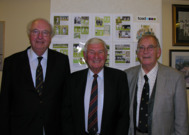
Award winning Derek Oldman flanked by Don Shepherd (left) and Edward Bevan.
Picture: Mike Taylor

We were doubly pleased to welcome to our most recent Meeting, on 10th November, two of the more eminent Welsh cricketing personalities. DON SHEPHERD is perhaps the most legendary Glamorgan player of all time - having in a career spanning the years from 1949 to 1972 notched up a little matter of 2218 First Class wickets - the highest number of victims ever achieved by any player not invited to appear in Test Cricket. EDWARD BEVAN, a distinguished journalist and broadcaster, has been the voice of Welsh Cricket on the BBC for three decades.

In introducing Don Shepherd Edward Bevan drew similarities between his fellow guest and his Derbyshire contemporary, Derek Morgan, who also took a phenomenal amount of wickets (to which he had added many runs and close-to-the-wicket catches) without ever getting even a "sniff" of a Test cap. Mr. Bevan felt that, had they played for more "fashionable" Counties both men might reasonably have expected to secure 30 England appearances.

It was clear, however, that Mr. Shepherd was far less interested in statistics than in the "Spirit" of the Game. His life-long enjoyment at having played First Class Cricket and the camaraderie and the many friendships that he had made meant a great deal to him. A bowler of off-cutters in his earlier days he had later switched - with enormous success - to off breaks. He had always relished his visits to Chesterfield - he had played no fewer than 11 times with Glamorgan in Queen's Park, the one major disappointment having been when the Team had once been more or less confined to barracks for four days in The Portland Hotel, heavy rain having meant that they never even managed to open their cricket bags.

The two speakers mulled over a range of cricketing topics - on which they were not always entirely in agreement - including covered and uncovered pitches, four day against three day matches, the One Day Scene and Twenty/20 - a format with which Mr. Bevan, in particular, had grown rather disenchanted. Inevitably, the famous 1968 Fixture between Glamorgan and Notts at Swansea - a Match in which Don Shepherd had played - received an airing. Interestingly, Edward Bevan told us that the Session of play during which Garfield Sobers hit his six consecutive Sixes was not broadcast live, but in order to allow trainee technicians to hone their art the BBC had allowed the Cameras to roll anyway and thus it was by sheer fluke that this epic slice of history was recorded for posterity.

During the evening Don Shepherd, on behalf of The Society presented the "Ray Buxton Service to Cricket Award" to Derek Oldman in recognition of his sterling service over the years in raising the profile of his local Club, Hundall.


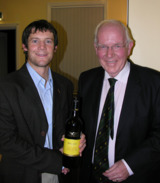
David Morgan opens for Chesterfield


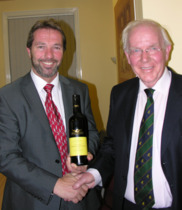
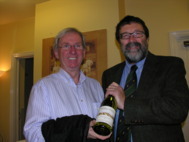
Chairman David Marshall presents David Morgan with a bottle of wine as a token of appreciation at the end of an enjoyable evening.
Picture: Mike Taylor

The Society's AGM was held prior to the introduction of the evening's speaker and tributes were paid to a number of members who had passed away over the previous year which sadly included Ian Buxton, the former Derbyshire player who was a founder member and a Vice President of the Society.

Chairman David Marshall then opened the new season by introducing the night's guest speaker, David Morgan. He had held the important position of President of the International Cricket Conference (ICC) until a few months ago when Sharad Pawar had taken over the reins, who as the Indian Minister for Agriculture, was a rare cricketer who prayed for rain.

David started by outlining the structure and role of the ICC and summarised some of the issues faced and successes achieved by what is effectively the world governing body for the game of cricket before going on to talk about the increasingly dominant position of India in the world game. This was in large part the result of India, almost uniquely, having only one major sport which means that for a large part of very large population, sport is cricket and cricket is sport. The introduction of Twenty 20 cricket, after a slow start, had really taken off in India and the increasing levels of affluence within the country was generating huge revenues for the game through the sale of media rights to the extent that India was in many ways the financial power house of the game.

Moving on to the state of the game, David felt that, at least from an international perspective, the game had never been stronger. The complementary formats of test, one day and Twenty20 cricket brought a strength and diversity in one game that is the envy of many other major sports. The game now extended across 105 countries and it was hoped that there would be significant developments in the future in both the USA and China. On the downside, David referred to problems and challenges in the game including issues of safety and security as well as worries over match fixing and spot fixing allegations. Overall, however, the ICC had a proud record and has recently celebrated its centenary with the establishment of a Hall of Fame.

After a short interval, David answered a range of questions including the use of floodlights in championship matches, the possibilities of four day tests, allegations of spot fixing, the future format of the county championship, the possible reduction in the number of first class counties (which he did not envisage), the apparent differences in the funding allocations to differing counties, whether there was too much cricket and his views on central contracts and umpire referrals.

There was warm appreciation for a thought provoking presentation which provided a very different and much broader perspective on the game and in thanking David Morgan for the illuminating evening, Chairman David Marshall presented him with the Society's customary bottle of wine.


The society exists to provide a point of contact for cricket enthusiasts and arrange meetings to enable those who wish to do so to remain in touch during the winter months. Anyone interested would be welcome as a guest at any of the meetings without a commitment to join until they decide whether they wish to.

We are the "senior" of the three societies in Derbyshire, having celebrated our 40th anniversary in 2003. We meet at the pavilion at Queen's Park. Meetings begin at 7.45 p.m. and are held monthly from October to April. The evenings vary from Monday to Wednesday. The annual subscription is £5.

Society Objectives

  1. To provide a source of contact between cricket enthusiasts everywhere and to promote, arrange and conduct meetings, social gatherings and other functions in order to enable members of the Society to meet one another and to encourage and facilitate the exchange of views and information concerning cricket.
  2. To provide such facilities for playing cricket as may be in the interest of members and of the game as a whole.
  3. To extend and explain the knowledge, appreciation and love of cricket amongst persons of all ages and all countries and to assist in any possible way towards the benefit of cricket players and all who are interested in the game.
 

Don't forget to visit the Derbyshire CCC website
Copyright © 2004-2012 Chesterfield Cricket Lovers' Society and CricketArchive CricketArchive Chesterfield Cricket Lovers' Society